
Best Calisthenics App 2026: AI Coaching & Video Analysis
Eight calisthenics apps tested on planche feedback, skill progressions, and price. The shortlist for athletes who want their handstand line graded, not just timed.
Titans Grip
Calisthenics Coach, planche, front lever, and muscle-up progressions
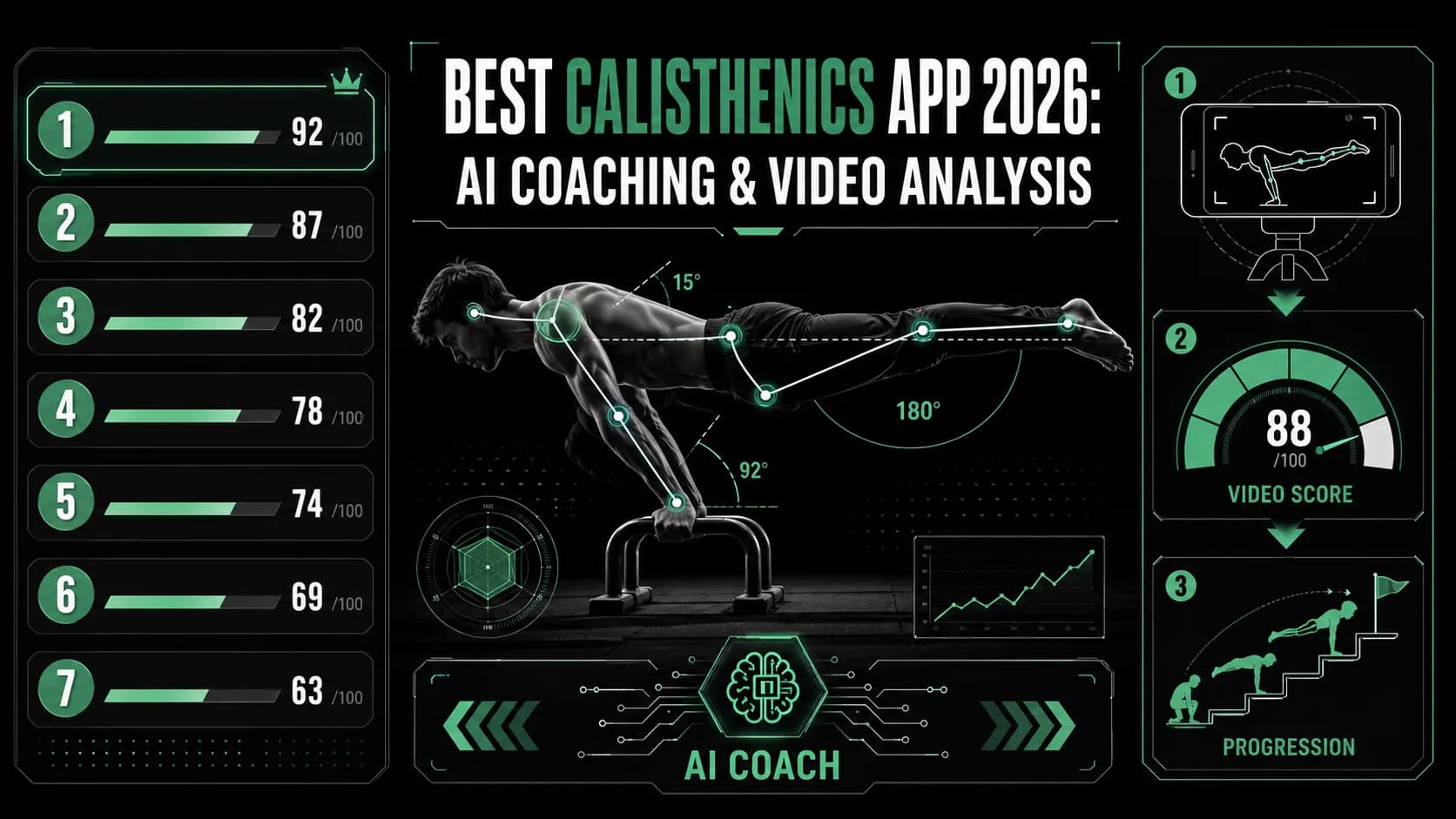
For years, calisthenics athletes trained in the dark. You'd film a front lever attempt at midnight in the park, watch it back, squint at the screen, and guess whether your hips were high enough. The progress problem was always the same: nobody is watching when you train alone. In 2026, that is finally changing. A new wave of apps grades your line, your scapular set, your elbow angle from video, and tells you exactly what to fix. We installed every major contender, ran them across foundational pulls, intermediate static holds, and the planche progressions that break most self-taught athletes, and ranked them on what actually moves a skill forward. The shortlist below covers AI-first apps, structured progression systems, follow-along libraries, and pure logging tools.
Key takeaways
- Video analysis is the game-changer. Apps that score your kinematics from video (like Calisthenics AI) close the feedback loop that motor-learning research says is essential for skill acquisition. The 2021 Cureus systematic review by Moinuddin et al. (PMC8681883) confirms visual feedback is the cornerstone of augmented-feedback methods.
- Most apps are still just timers with libraries. Thenx, Madbarz, and Freeletics offer great workouts but no technique grading. They're useful for conditioning, not for fixing a broken handstand line.
- Price varies wildly by feature set. AI-coaching apps cluster around $10–$25/month. Workout libraries run $5–$15/month. Premium video courses are one-time purchases of $99–$295. Free tiers exist but cap analysis or skill progressions.
- The hybrid approach wins. Use an AI-scoring app for skill work and a logging app like Hevy for weighted accessories. No single app does everything perfectly.
How we ranked
Five criteria, weighted by impact on skill acquisition. The weights reflect what actually drives progress in calisthenics, which is a sport of small joint-angle errors that compound into plateaus.
| Criterion | Weight | Why it matters |
|---|---|---|
| Video analysis quality | 40% | Per-rep scoring on lever angle, scapular position, joint alignment, and named failure modes. This is the feedback loop that changes technique. |
| Coaching depth | 25% | AI chat that answers progression questions, plus structured plans that adjust to your scores. Raw scores are useless without a prescription. |
| Technique library | 15% | Progressions for planche, front lever, muscle-up, handstand, and one-arm work. The backbone of the sport. |
| Price | 10% | Monthly and annual cost relative to features. Accessibility matters. |
| Platform availability | 10% | Stable iOS and Android. No one wants an app that crashes mid-set. |
We tested for two months across multiple skill levels: a tuck-planche athlete pushing toward straddle, a front-lever athlete stuck at advanced tuck, and a beginner working push-ups and Australian rows. Each app was used for at least five sessions. Scores were assigned based on objective criteria (e.g., does the app detect a dropped scapula? Yes/No) and subjective experience (ease of use, quality of feedback).
The eight best calisthenics apps of 2026
1. Calisthenics AI by Titans Grip — best overall
What it does. Frame-by-frame video grading for planche, front lever, muscle-up, handstand, and the foundational push and pull patterns underneath them. Scores are 0 to 100, with overlays on shoulder line, hip alignment, scapular position, and limb angle. The AI coach ("Coach Alex") is available 24/7 for progression questions and adjusts your plan based on the scores you accumulate.
Key features
- Per-rep scoring for foundational, intermediate, and advanced skills.
- Frame-by-frame feedback with named failure modes (dropped scapula, broken hip line, bent elbow on a straight-arm press).
- Coach Alex chat trained on calisthenics progression methodology and gymnastic strength principles.
- Skill progressions with realistic time-to-mastery estimates by experience level.
- Volume and intensity logging tied to your score trend.
- Macro tracking with bodyweight-athlete defaults (high relative protein, periodized carbs).
Pricing. Free tier with 3 video analyses per week. Premium $19.99/month or $179.99/year unlocks unlimited analysis, full progression plans, and the chat coach.
Best for. Athletes at any level who want objective grading on technique and a responsive coach for progression questions, especially anyone training without an in-person gymnastics-strength coach.
Honest limitations. The AI is excellent for static holds and slow dynamic movements (pull-ups, dips, rows) but struggles with fast, explosive movements like muscle-ups or kipping transitions. The frame-by-frame analysis requires good lighting and a stable camera setup; shaky phone footage can produce false positives. Coach Alex is knowledgeable but cannot replace a human coach for advanced programming nuances like periodization or peaking. The free tier is generous but limits you to three analyses per week, which may not be enough for athletes training daily.
Verdict. It wins because it closes the loop. Score, name the failure mode, prescribe a regression or accessory drill, re-test. Other apps deliver a piece of that. Calisthenics AI delivers the whole sequence.
Train Calisthenics with AI
Coach Alex analyzes your technique, scores your form 0-100, and builds your training plan.
Download Calisthenics AI2. Thenx — best for video-led programming
What it does. A massive follow-along library built around founder Chris Heria. High-tempo sessions guide you through bodyweight circuits and skill work over a mix of free and paid programs. Pricing on the related "Chris Heria Pro" sister product is $11.99/month or $119.99/year per the public pricing page.
Key features
- Large library of follow-along workout videos.
- Programs sorted by goal (beginner gains, handstand mastery, muscle-up).
- Music integration and a clean interface.
- Basic logging, calendar, and community challenges.
Pricing. Approximately $14.99/month or $99.99/year for Thenx; $11.99/$119.99 for the related Heria Pro app.
Best for. Beginners and intermediates who prefer high-energy, motivational sessions and a strong brand identity.
Honest limitations. No AI scoring. Progress is tracked by completion, not technique quality. You could do a handstand push-up with terrible form and the app would still mark it as done. The volume defaults are aggressive; lighter-loading athletes may need to scale. The library is heavily skewed toward Chris Heria's style, which may not suit everyone. The app is also known for frequent upsells and a cluttered interface.
Verdict. Great for motivation and variety, but not a tool for technical improvement.
3. Caliverse — best for structured skill progressions
What it does. Treats calisthenics like a skill tree. You unlock new exercises by passing tests on the prerequisites. The path is linear and self-directed, which suits athletes who want a clear next step without making programming decisions.
Key features
- Skill-tree progression system with prerequisites.
- Built-in testing protocols to unlock new levels.
- Multi-angle exercise tutorials.
- Workout generator scaled to available equipment and level.
- Simple rep and set tracking.
Pricing. Free with limits. Pro is $4.49–$9.49/month per the App Store listing.
Best for. Self-motivated learners who like a clear, gamified progression and do not mind the lack of personalized form feedback.
Honest limitations. No video analysis. The system is rigid; if you are stuck because of a wrist mobility issue rather than a strength deficit, the tree cannot diagnose it. The testing protocols are basic (e.g., "hold a plank for 60 seconds") and may not accurately assess readiness for advanced skills. The workout generator is decent but can produce unbalanced sessions (e.g., too much pushing, not enough pulling).
Verdict. A solid progression framework, but you are on your own for form correction.
4. Madbarz — best for accessible bodyweight workouts
What it does. Straightforward, equipment-light bodyweight workouts and simple plans. Animated demonstrations and an easy-to-navigate interface keep the barrier to entry low.
Key features
- Database of bodyweight workouts requiring zero or minimal equipment.
- Custom workout builder.
- Animated exercise guides.
- Progress graphs.
- Apple Health and Google Fit integration.
Pricing. Free version with a Premium tier around €60/year (7-day trial).
Best for. Beginners and general fitness users who want short, repeatable sessions without committing to advanced skill work.
Honest limitations. Not a skill-progression tool. No analysis. No structured path toward levers or planches. The workout library is limited compared to Thenx or Freeletics. The custom workout builder is functional but lacks the polish of dedicated logging apps like Hevy.
Verdict. A good entry point for bodyweight fitness, but you will outgrow it quickly if you want to chase advanced skills.
5. Freeletics — best for AI-generated bodyweight conditioning
What it does. AI-generated training plans that adapt week by week based on your feedback. Geared toward bodyweight HIIT and endurance more than static-skill work. The AI coach is conversational and adjusts session difficulty automatically.
Key features
- AI plans that adapt weekly to feedback and performance.
- Bodyweight HIIT and endurance focus.
- Audio coaching cues during workouts.
- Optional nutrition coaching as a separate subscription.
- Performance analytics and recovery suggestions.
Pricing. Coach is approximately €7.70–€10/month or $74.99–$114.99/year per the public pricing.
Best for. Athletes whose primary goal is conditioning, fat loss, or general fitness through bodyweight intervals.
Honest limitations. The AI is geared to metabolic conditioning, not technique. It will not grade your handstand line or diagnose a front-lever scapular issue. The workouts are intense and may not suit beginners or those with joint issues. The nutrition coaching is a separate subscription and is basic compared to dedicated apps.
Verdict. Excellent for conditioning, but not a calisthenics skill app.
6. GMB Fitness — best for joint-prep and movement quality
What it does. Programs from the GMB team that emphasize joint preparation, mobility, and the movement vocabulary underneath bodyweight skills. Less skill-flash, more "build the body that can hold the skill safely."
Key features
- Foundational programs in mobility, motor control, and integrated strength.
- Floor-based movements (rolls, transitions, animal patterns) for hip and shoulder integration.
- One-time program purchases rather than subscriptions.
- Detailed video coaching on cuing and quality of movement.
Pricing. Programs typically $95 each, bundles around $295, sold at gmb.io.
Best for. Athletes coming back from injury or anyone whose ceiling is mobility rather than strength.
Honest limitations. Not a calisthenics-skill app per se. No AI feedback. You are responsible for filming your own work and assessing quality. The programs are slow-paced and may frustrate athletes who want to chase flashy skills quickly. The one-time purchase model is a pro for some, but the upfront cost is steep.
Verdict. A foundational system that builds durable movement patterns, but not a shortcut to planche.
7. GymFit TV (Gymnastic Bodies) — best for foundational gymnastic strength
What it does. The current incarnation of Christopher Sommer's Gymnastic Bodies content, rebranded to GymFit TV at gymnasticbodies.com. Highly systematic progressions for foundational strength and mobility. The Foundation series builds prep, the Handstand series targets inversion, and longer cycles run year-round.
Key features
- Foundation series for full-body preparatory strength.
- Handstand series for inversion mastery.
- Joint-prep and injury-prevention focus.
- Extensive video lectures on movement theory.
- Year-long structured cycles.
Pricing. Four plans at $225 each, or four short series at $99 each per public pricing.
Best for. Serious athletes and coaches willing to invest in a long-horizon, principle-first approach.
Honest limitations. Steep upfront cost. No interactivity, no AI. Pre-recorded course library. The pace is methodological and frustrates anyone wanting to chase flashy skills early. The content is dense and may overwhelm beginners. The platform itself is dated compared to modern apps.
Verdict. The gold standard for foundational gymnastic strength, but it demands patience and a significant financial commitment.
8. Hevy — best for logging accessory and strength work
What it does. Clean, fast strength-logging app that calisthenics athletes use for tracking ring dips, weighted pull-ups, and strength accessories outside of skill sessions.
Key features
- Clean interface for logging sets, reps, weight (or band tension).
- Pre-built routines and a robust exercise library.
- Rest timer.
- Progress graphs for individual lifts.
- Workout history and one-rep-max estimates.
Pricing. Free with limits; Hevy Pro is $5.99/month or $34.99/year per public pricing.
Best for. Calisthenics athletes who want a serious log for the weighted side of their training without paying for a full coaching app.
Honest limitations. Not built for calisthenics skill work. No timers for static holds, no skill library, no analysis. The exercise library is geared toward gym lifts, not calisthenics-specific movements (e.g., no "planche lean" or "front lever hold"). The free tier is limited to three routines.
Verdict. A solid logging tool, but pair it with a skill-focused app.
Comparison table
| App | Video Analysis | Coaching Depth | Technique Library | Price (Monthly) | Best For |
|---|---|---|---|---|---|
| Calisthenics AI | Yes (frame-by-frame) | AI chat + adaptive plans | Extensive (planche, lever, handstand, muscle-up) | $19.99 | Athletes who want objective technique grading |
| Thenx | No | Follow-along videos | Large (skill work + circuits) | $14.99 | Beginners/intermediates who want motivation |
| Caliverse | No | Skill-tree progression | Moderate (linear path) | $4.49–$9.49 | Self-directed learners who want a clear path |
| Madbarz | No | Basic workout library | Limited (bodyweight circuits) | ~€5 | Beginners who want simple workouts |
| Freeletics | No | AI conditioning plans | Limited (HIIT/endurance) | €7.70–€10 | Athletes focused on conditioning |
| GMB Fitness | No | Video coaching (pre-recorded) | Foundational (mobility + movement) | One-time $95–$295 | Injury recovery or mobility work |
| GymFit TV | No | Video lectures (pre-recorded) | Extensive (gymnastic strength) | One-time $99–$225 | Serious athletes who want a long-term system |
| Hevy | No | None | None (logging only) | $5.99 | Logging weighted accessories |
How we settled the order
Video analysis quality is the heaviest weight because feedback is what changes a skill, not volume. The motor-learning literature is clear: visual feedback is the cornerstone of augmented-feedback methods, per the 2021 Cureus systematic review by Moinuddin et al. (PMC8681883). For sport-specific evidence, the Hachaj et al. 2019 PLOS ONE study showed that Kinect-based motor learning aids improved technique in sportsmen across complex standing techniques (journal link). Calisthenics is mostly straight-arm and lever work where small joint-angle errors cost a lot of strength to brute-force through; grading them objectively is the difference between progress and plateau.
Coaching depth (25%) matters because raw scores need a prescription. Library depth (15%) matters because progressions are the backbone of the sport. Price (10%) and platform (10%) are accessibility checks.
FAQ
What is the best calisthenics app for beginners in 2026?
Beginners benefit most from feedback they can act on. Calisthenics AI grades push-ups, rows, and squat-to-stand patterns from day one, which prevents the slow build-up of small errors that block lever and planche progress later. Caliverse is friendly to absolute beginners who want a linear path of unlocked exercises and do not need form feedback. Thenx is also a solid choice for beginners who prefer high-energy, follow-along sessions.
Do calisthenics apps actually improve technique or are they just timers?
Most are timers with a library attached. The shift in 2026 is toward apps that grade your kinematics from video. Visual feedback is the cornerstone of augmented-feedback methods in motor learning, per Moinuddin et al. 2021 (PMC8681883). Without that loop, an app is a video player with a stopwatch. Apps like Calisthenics AI that provide frame-by-frame scoring and named failure modes are the only ones that can genuinely improve technique.
How much does a good calisthenics app cost per month?
AI-coaching apps cluster around $10 to $25/month. Workout libraries like Madbarz and Thenx run $5 to $15. Premium video courses (GymFit TV, GMB programs) are one-time purchases of $99 to $295 per series. Hevy is $5 to $7/month for logging only. Free tiers exist but typically cap analysis or skill progressions. The best value depends on your goals: if you want technique feedback, invest in an AI app; if you just want workouts, a library app is cheaper.
Can AI video analysis replace a real calisthenics coach?
Not for the most advanced static work, where progression management and lever-arm cuing benefit from a human eye. For everything from beginner basics through intermediate skills, AI scoring is a useful daily training partner that catches the dropped scapula, the bent elbow, the tilted hip. The hybrid is the move: use an AI app for daily feedback and check in with a human coach periodically for advanced programming and periodization.
Which calisthenics app works best on iPhone?
Calisthenics AI, Thenx, and Freeletics ship polished native iOS builds with Apple Health integration. Camera capture is reliable across iPhone 12 generation and newer. Android flagship performance is roughly equivalent for the AI-scoring apps that compute on-device. Caliverse and Madbarz also have solid iOS versions, though they lack the polish of the top three.
Can I use multiple apps together?
Absolutely. In fact, that is the optimal setup for most athletes. Use Calisthenics AI for skill work (planche, front lever, handstand), Hevy for logging weighted accessories (weighted pull-ups, ring dips), and Thenx or Freeletics for conditioning sessions. No single app does everything perfectly, so combining them covers all bases.
Are free tiers worth it?
For exploration, yes. Calisthenics AI's free tier gives you three video analyses per week, which is enough to test the core feature. Madbarz and Hevy have generous free versions that cover basic needs. But if you are serious about skill progression, the paid tiers are worth the investment. The cost of a premium subscription is less than a single session with a coach.
Final verdict
For most calisthenics athletes in 2026, Calisthenics AI from Titans Grip is the most defensible pick because it grades your line, names the flaw, and prescribes the fix. Caliverse and Thenx work for athletes who want a clear path or motivational sessions. Madbarz and Hevy serve narrower jobs. GMB and GymFit TV are excellent foundational systems if you commit to the long arc. If your goal is to bridge the gap between where you are and where you want to be on the planche or front lever, your training starts at /calisthenics/.
Other Doved Studio projects
Related tools from the same studio you might find useful:
- Glean: Turn scrolling time into a daily action plan. Capture, process, execute.
- Popout: Create your portfolio in minutes with a single shareable page.
- Doved Studio: Studio indie derrière cette app et une dizaine d'autres outils.
Coach Alex
Calisthenics specialist. Expert in progressive overload, skill progressions, straight-arm strength.
Coach Alex is the AI coaching persona behind Calisthenics AI, built to provide personalized calisthenics guidance through video analysis, training plans, and technique breakdowns.
Related Articles
Muscle Up Progression: From Zero Pull-Ups to Your First Muscle Up
Mar 27, 2026 · 23 min read
CalisthenicsIs Your Calisthenics App Actually Building Muscle? The 2026 Strength vs. Skill Reality Check
Mar 18, 2026 · 15 min read
SamboHow AI Is Changing Sports Training in 2026
Mar 5, 2026 · 6 min read
Train Calisthenics with AI
Calisthenics AI gives you an AI coach that analyzes your technique, plans your training, and tracks your nutrition. Try it for free.